How to Split Bills Fairly in a Relationship (Without It Turning into a Row)
I was writing my mailing list for this week - about the way that I write my financial notes in a pleasing fashion - and I found myself explaining a little of mine and Dr Chris’s personal financial setup and how we split bills fairly as a couple. I don’t need to go into too much detail of course, and we are a bit unusual (mostly because of the way my brain works), but that will go in this coming newsletter.
It got me thinking a bit about how to deal with money in relationships though and how to join finances fairly and equally with a partner. This is a big topic and there’s no way I’ll cover it all here. If the personal is political, then the way we deal with money in our personal relationships has a big impact. It’s also the sort of thing that can be difficult or uncomfortable to think about and discuss - all the more reason to do so!
How to Split Bills Fairly in a Relationship (Without It Turning into a Row)
There’s a particular kind of silence that can happen when somebody says ‘I think we need to talk about money’. I’m sure you know the one - you can see somebody’s shoulders go up around their ears, stammering, maybe accusations. The questions might be about who pays for what, where you’re headed and what goes where but the bigger questions are ‘do you see my value? Are we equal? Do you respect me?’
I have covered this multiple times already with my clients - mostly people who want to explore their feelings before taking it to partners but notably with one woman who was mid breakup, which was in part to do with money incompatibility. This stuff is serious and personal - there is no universally ‘fair’ way of doing it. There is a way, or ways, that will work for the two (or more) humans in the actual relationship and even when worked out properly and in good faith, this will likely need to be revisited over the course of a long term relationship because life changes. Constantly.
Let’s have a look at some of the models, maths and messy stuff underneath it all.
‘Fair’ and ‘Equal’ Are Not the Same Thing
This is super important. Equal is not the same as fair.
Equal gives everybody the same tools. Fair (or maybe you could call this equitable) gives extra help or tools to the people that require it so that they have as close to the same chance to succeed as the other as possible.
Splitting every bill straight down the middle feels fair because it’s simple and symmetrical. But if one of you earns £65,000 and the other £24,000 then a 50/50 split isn’t neutral, it’s asking the lower earner to hand over a much bigger proportion of their actual life - it means they can go on fewer nights out, save less, have fewer choices.
‘Equal’ treats the money as the fixed point. ‘Fair’ treats the people as the fixed point and bases the money around that.
What might that look like? Well, we’re about to explore but let’s say, it’s a genuinely different starting point and one that couples (or throuples or whatever) might not have considered. This, to me, is clearly one of those beliefs that we inherit from parents, caregivers and society in general. The baggage can be unreal!
The Main Ways Couples Split Bills (and Who They Tend To Suit)
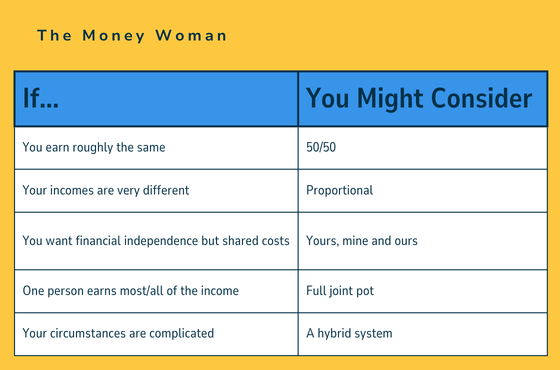
There's no perfect system, there's the one that fits your circumstances right now. Here are the ones I discuss most often.
The 50/50 Split
You add up the joint costs - rent, bills, food, whatever you have agreed counts and split it right down the middle.
This tends to suit couples who have similar incomes and financial values - or people who feel strongly about total independence and don’t want money to create a sense of debt or obligation between them.
A definite positive is that it’s simple to administer. Notable downsides are when incomes diverge, when one person’s outgoings increase in ways which the other feels shouldn’t be in the ‘shared’ costs and then more specific circumstances like paying for a partner’s kids from a previous relationship or perhaps supporting aging parents.
Proportional to Income
You would work out the percentage of the combined household income that both (or all) of you earn, and each contributes that same percentage towards the shared pot.
Note this also, probably, requires you to have worked out the joint costs, as above. So if you earn 70% of the household income and your partner earns 30%, and your shared monthly costs are £2,000, you would contribute £1,400 and your partner £600.
For some couples, this can feel like a good middle ground because it responds to differences in income rather than pretending everybody starts from the same place.
It does mean that people have to be transparent about their earnings and that honesty can be a bigger ask than the maths itself to be honest. If you’ve grown up in a family, culture or country where talking about money or earnings was a no-no, and I would bet that most of us have, then there will be a level of discomfort that comes straight to the surface. It might feel easier said than done, but my advice is to do what you can to make that feeling of discomfort manageable (lots of thoughtful planning beforehand, notes, deep breathing, checking in with each other) and then just get it done. You don’t have to decide everything all at once, this might take a few discussions, but you - and your partner(s) - are worth the trouble.
The Full Joint Pot
Everything goes into one account and everything comes out of one account. There’s no ‘my money’ and ‘your money’, just ‘our money’.
This feels less common to me than it once did, I’d even go so far as calling it old-fashioned, but I don’t mean that in a derogatory way and have seen it work very nicely. It particularly suits couples where one party earns way more, or is even the sole-earner, and also couples that are pretty equal earners.
One major positive is the lack of admin, no mental tallying and a sense of ‘we’re in this together’. To work properly there needs to be a high baseline of trust and reasonably aligned spending values. This is much less likely to work if one partner is a saver and the other a spender and neither one is interested in an honest conversation. I can imagine that every purchase could descend into a referendum on the entire relationship - ‘are you even trying to save money?’
A big cautionary note here - being a coach primarily focused on women and non-binary people - and us being the people who traditionally earn less - whilst this might be the legitimately best choice for your relationship, it shouldn’t override you having separate access to money. Every person should have access to the resources they need to leave if they need to, rather than being beholden to another person - however much you love and trust them.
Some Admin Thoughts on the Actual Setup
Yours, Mine and Ours.
This would apply to the 50/50 and proportional split options. It requires three accounts - one for joint costs and two individual ones that are entirely your own business. You each contribute an agreed amount to the joint pot and everything left over is yours to do with as you like - guilt-free.
This has been used successfully as a sort of rehabilitation when one partner is coming out of a relationship where money was used to control them, or where they’ve simply never had financial autonomy and want it. It preserves independence whilst still funding a shared life. It requires a certain level of admin but for a lot of people it’s worth it for the peace of mind.
Individual Bills.
Another option would be for each partner to take responsibility for specific bills. One takes the mortgage and phone bills for example, the other takes the insurance, gas, electricity, water and food.
If you’re interested in keeping this either ‘fair’ or ‘equal’ then it requires a certain amount of admin to make sure that the proportions still fit over time as bills go up (or possibly even down…).
It also requires a level of trust that the bills are going to be paid, that you’re going to be informed of any changes and it could add a level of friction based on lack of access to accounts either in an emergency or simply if you want to know or change something. There is a simplicity though, especially if one partner moves into a property that the other owns or if you each come with contracts you’d rather keep.
Who Does the Work?
This is going to depend on each individual’s preference and requires a level of understanding and accommodation if those levels don’t match. One partner may require a spreadsheet breakdown and precise figures, whereas the other is happier to go with the flow and work on rounded numbers. There’s really no right or wrong here, either can work, as long as financial anxiety isn’t taking over or, on the other hand, the more relaxed partner is putting in some effort.
All of these styles will require some level of labour and another way that the ‘fair’ and ‘equal’ split could raise its head is in how much effort either partner puts in. Is one partner always asking the questions? Always suggesting the meetings? Always the one checking the accounts and making sure everything is paid? This is work which has a financial impact and could interplay in the workings out of what is fair or not - certainly something worth considering in terms of unbalanced incomes. I’m not suggesting that the person earning less should do more to ‘make up’ for a lack of income, but financial management (and household management, rearing children etc) certainly costs something if you have to pay out of house for it.
What These Systems Don’t Fix
None of these systems or thoughts will fix an underlying trust or communication problem. It might paper over it for a while or it could genuinely help if the problem was more structural. Financial issues can be a huge issue in relationships and working together to solve a problem could be genuinely reparatory if everybody comes together in good faith.
If one partner feels unseen, unheard or like their contribution - paid or unpaid - doesn’t count as much as their partner’s, well, no formula is going to sort that.
Unpaid labour comes up a lot in my sessions and it rarely makes it into the maths. If one person is working full-time and the other does the lion’s share of childcare, housework and household admin then ‘fair’ isn’t about who earns what - it’s about factoring in the value of that unpaid work. In this case, a proportional approach can look ‘fair’ on paper but is actually much more like the 50/50 split between the couple earning £65,000 and £24,000 from before - which will feel deeply unfair to live inside.
In 2023 the value of unpaid household labour in the UK was £1.7 trillion or 61% of GDP and of course most of that unpaid care work was undertaken by women (in both England and Wales).
This is really the kind of thing we can talk about in money coaching. Getting into the details of it, bringing up memories attached to some of the emotions and feeling out solutions which might make things feel better in your specific circumstances. Then we can take it further and discuss implementation, ways that you might bring it up with your partner and methods for making that feel safe and productive for everybody involved. It’s not just about the numbers, it never is, but they are important too!
A Few Honest Questions To Ask Each Other
Rather than starting with ‘how should we split the bills?’, how about starting with these instead?
Get used to talking about the emotions of money - the feelings, the fairness, the consequences - to allow the figures to flow more naturally. The system that works might fall quite naturally into your laps once you’ve thought about this stuff honestly.
You don’t have to sit down and have A. Big. Talk. This could be a chat in the car on your way to ASDA. You could also double down and have a big old money date with wine, and notes and intentional questions. Whatever works for you.
What did money look like in each of our families growing up? Who controlled it? Who worried about it? Who did the admin? Who never discussed it at all?
Do we associate financial independence with safety? Or does merging money feel safer? Do we associate how we deal with our finances with commitment and love? Do we feel hurt by our partner’s answers?
What counts as a ‘shared cost’ and what doesn’t? Gifts for each other’s families? Subscriptions that only one of you uses? The dog that both of you wanted but only one of you walks?
How will we handle it when one of our incomes changes significantly? Does it matter if that’s by choice or not? Talking redundancy, a new baby, a career change, an inheritance.
Whose job is the financial admin and do they feel resentful about it or genuinely fine? Is the other one aware of what goes into it? Is there a way to change the balance of work?
There is no right answer to any of these and of course, the answer might change over time. What matters more than the end point in that case, is that you’re both sitting together and sharing in honesty - spending time on your relationship and proving that you are in it together for the support of one another. This matters much more than the structure that you decide on.
When to Revisit the System
None of this has to be permanent. In fact, it probably shouldn’t be. My philosophy is always ‘done is better than perfect’ and moving towards something is better than avoiding it altogether. Circumstances will change - in your personal lives, your family lives, in your community and in the world at large - so you must plan for changes to be made.
I’d be looking at a low-stakes but intentional annual check-in even if nothing has dramatically changed. This would be the place to check out balances and make changes to accounts.
But I think a monthly, or every two months, personal check in to make sure that everything is being taken care of, no resentments are creeping in and there is a chance to discuss this stuff outside of having an argument. Again, it doesn’t have to be a big to-do but it absolutely could be if you like that kind of thing.
The Bit to Remember
I really want you to know, there is no moral high ground to any particular bill-splitting system. You are not a better couple, or worse, because you share bank accounts or because you keep your finances separate. Full joint accounts are no more committed than separate ones and a 50/50 split isn’t more ‘equal’ than a proportional one if it’s bankrupting the lower earner.
The real test, and I think a much better indicator of a ‘good’ relationship, is if each partner feels heard, respected and secure - and I would add that you can actually talk about the big stuff (money included) without it turning into a row.
If the last part is a sticking point and this has made your stomach tighten a bit - this is information worth listening to. I would suggest that it means that the conversation you need to have isn’t about spreadsheets at all. This is exactly the type of conversation I love to help people with in coaching - not necessarily about the maths - but the much harder part of actually saying out loud the thing that you need to, to the person across the kitchen table.
Love Eleanor xxx
P.s. need some help working out