I'm Reading Profit First, Again.
This is maybe my fourth time and each round I hit something different. This time I'm really relating to all of the diet culture stuff but, let me slow down a little and explain myself because I don't think this book has made it into the main-mainstream even if it is a pretty well known business book.
If you have a business, of any size, read it. Absolutely without a doubt, read it.
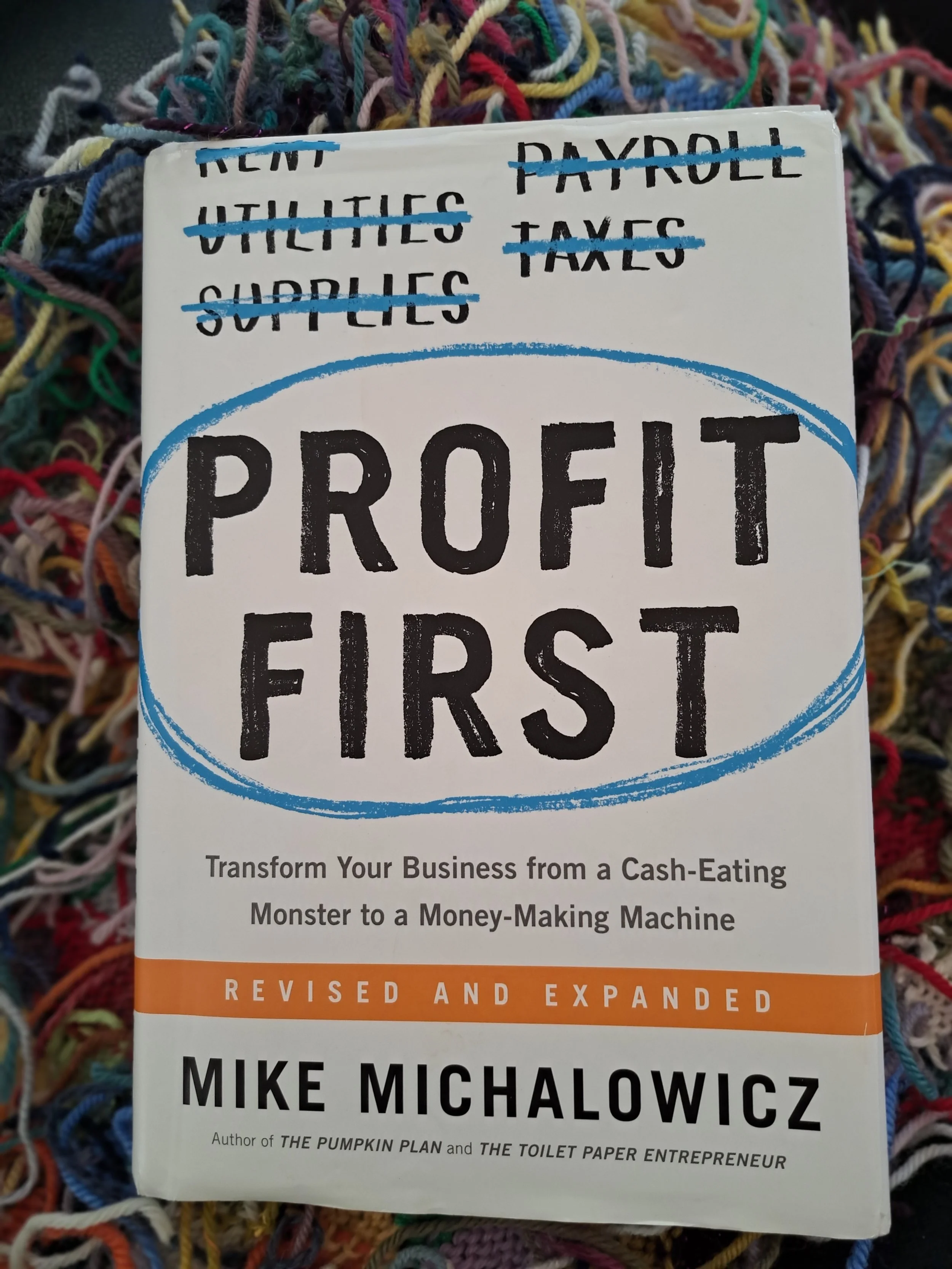
My dog eared copy. (And for any crafters out there, yes I have to sew in all of those ends…)
The Premise of Profit First*
So when you have a business your gross profit comes from adding up everything that you sell (products or services), then you take away everything that you pay in the course of doing that business (staff, office space, inventory, consumables etc.) and what's left is your net profit.
Broadly speaking, this is what you pay tax on. This isn't taking into account VAT and of course it works a little differently between self-employed/sole-proprietors and limited businesses. There are huge differences in scale too, but it should apply as much to me as it does to Google (although I'm not having meetings at Downing Street but we digress…).
The problem is, that net profit number, which is what gets written down on a tax return, is often just a number written down on a tax return.
The reality in business is that money isn't just sat there waiting to be plucked from your bank account and enjoyed as profit. It's often already been spent and every business owner I know (including myself!!) talks about 'ploughing it all back into the business'. Which presumably means that we're hoping that ‘re-investing’ that money now will eventually lead to profit at some unspecified time.
I honestly thought, for a really long time, that this was business and that profit was just sort of… not really a thing. I know that sounds wild but when you're actually in it, that's how it seems.
This is also how Mike Michalowicz felt. Even though he had businesses making many-many times what I was, he was in the same situation. It's incredibly common.
Think back to any little businesses you follow online, in an effort to offer transparency they might offer some numbers about how much they take and spend on an event, for example, and you can hear them saying - ‘I know this looks like a lot but I'm not making very much at all!!’
The Solution of Profit First
Is to take the profit first.
There we go. Done. Goodbye.
Love Eleanor. xxx
Obviously, it's a little more complex than that…
And the way he talks through the numbers and the systems he puts in place is really detailed (although written to be really easily read).
Essentially, every time money comes into the business you distribute it, according to set proportions, between a profit account, an owner's wages account, a taxes account and an operating expenses account. Operating expenses are everything you pay in a business which isn't your profit, owner wages or taxes - so inventory, electricity, insurance, phone bill, rent etc.
With help of the book, your own common sense and your accounting figures, you work out how the money is to be appropriately split between these four sections - expressed as a percentage. You start from where you are - which is often putting 0% into the profit and wages sections and not enough into the taxes section, and over time you adjust those percentages so that in the end it aligns perfectly with your aims.
The idea is that over time, your operating expenses (which are probably far too high) reduce, which means that you can put more money into the profit, wages and taxes account but…
and this is probably the most important part of the book…
That’s Not How Human Nature Works
It’s absolutely human to think that the operating expenses can't be reduced and don't need to be anyway, because you're scraping by - you're getting paid from the leftovers, you can always scrape your taxes together and there's a profit written on the tax return at the end of the year. In that case, there's no way you would reduce operating expenses to add to the profit, wages and tax.
So the key to it all - and the name of the book - is, you pay your profit first.
This is physical, as in, it's always the first distribution you make, but it's also when you're reallocating your percentages - you increase what you're paying into your profit, wages and tax allocations which means therefore, that you have to reduce your operating expenses.
1% by 1%- it doesn't have to be drastic, but it does have to be done.
You know how if you had all day to do something it would take all day but if you only had an hour you'd get it done? Or how if your best mate turned up and needed dinner you would make whatever you had in stretch? Or how when you have no money, you somehow make shit happen? Well the same applies to operating expenses, you might be spending £100 now but if you had to get by on £90, you simply would.
The Practical Application of Profit First
This is incredibly important for businesses - but it's also important for individuals (and he's written a book, called The Money Habit*, about how to apply Profit First to normal life although I haven't read it yet).
You can decide to allocate 1% of your income to investing which leaves you with 99% for 'operating expenses'. Next quarter you up that to 2% which leaves you with 98% for operating expenses and then 3% to 97% and so on. You would make that reduction in operating expenses happen.
The cognitive shift it takes to decide to pay yourself first is absolutely key. It might feel silly at first, it might feel too little, or too selfish, or too serious but it is none of those things.
You take care of the things that you love.
To finish up...
As always, I wrote a little more than planned here. I also have decided to go to only post one blog a week (not including Pocket Money which I hope you're loving!) so let me talk about the diet culture links in this week's newsletter. Because this whole, incredible theory, was literally devised based on a lot of diet culture stuff and I have found it so interesting!
Want to read about the diet culture links? That's in this week's newsletter.
Love Eleanor. xxx
*That’s an affiliate link, so I get a bit of money if you choose to buy through it.
