The Importance of Awe: Lessons from Amanda Montell on Mental Health, Money, and the Recency Illusion
(Please note all the links to books in this post are affiliate links, so if you buy them through that link then I will receive a commission which is great. I would be just as thrilled if you borrowed them from the library or bought it from a local book shop though.)
Fun Books and Business Books
There are books I read for fun and books I read for the business (although I think they’re kind of fun too) and I keep them quite separate. I read them in a different way, I make notes from the business ones, place bookmarks and try to find correlations with other stuff I’ve read or thought about. I aim to read with writing a blog post or social media post in mind, or just to increase my general knowledge.
The Age of Magical Overthinking: Notes On Modern Irrationality was definitely of the former - fun - variety. Amanda Montell is the host of one of my fave podcasts, Sounds Like A Cult and I remember her releasing this book but not quite getting as far as buying or borrowing it. When I saw it one day, nestled on the shelf in the library, I knew I had to take it home with me and I am delighted with it!
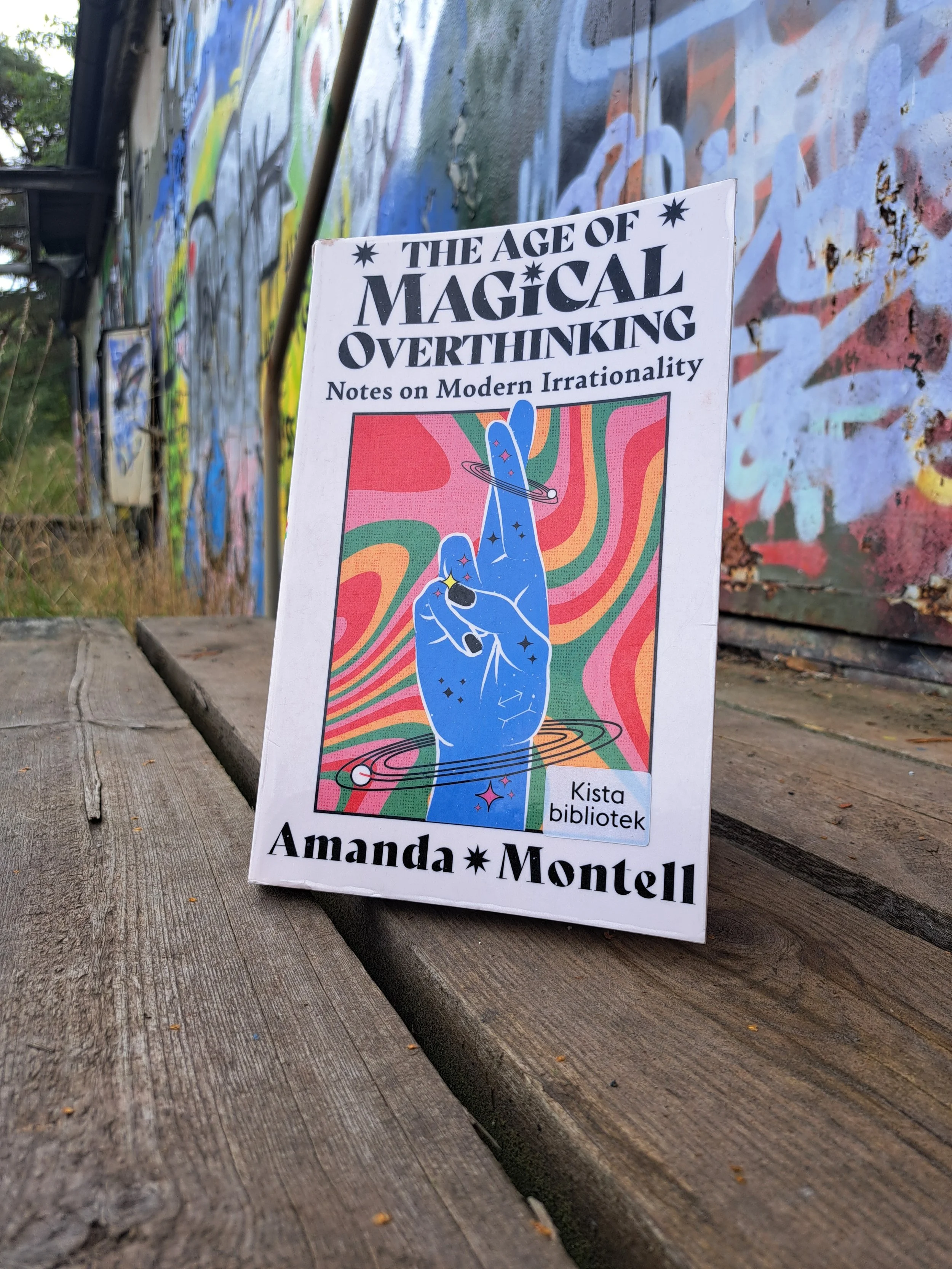
It’s a cool looking book huh!
A Review of The Age Of Magical Overthinking by Amanda Montell
It’s formed as a series of essays really, each about a different cognitive bias and she’s got a really singular way of bringing her life and experiences together with collective experiences (like the pandemic or Taylor Swift fandom) with various scientific fields, especially psychology and sociology.
Everything feels really well researched but not obvious. Like she’s been out rustling up information from a lot of little nooks and crannies and is able to weave them together so it all makes sense. One point illuminates the other, which sheds light back. It’s clever!
Given that this is a fun book, and I didn’t take notes as I was going, I am just going to talk on one point which she made and which has really stuck with me.
The Importance Of Awe
I guess it’s stuck with me because I’ve passed it on so many times myself. I talk a lot about mental health, it’s something that I’ve struggled with, in large part ‘overcome’ or maybe more like - come up with some strategies that work for the most part, and I’m very open in talking about it. So I end up speaking to a lot of people and one of the main strategies I suggest is finding ✨awe✨.
It works because that means different things for different people - for me it’s usually struggling to the top of a high place so that I feel dizzy and a little sweaty and I can look down and around at a large expanse of something. Or it’s about being in or on or next to water. If I can do either of those regularly I know I’ll feel tame.
But for other people it’s music, or theatre, crafting, people watching, films, being in a choir, gardening, baking, make up, religion, clubbing - goodness knows. We’re all different, but we all have the ability to connect to something bigger, more creative, more inspiring - something to take us out of ourselves for a time.
Literally The Recency Illusion
Amanda connects that to the Recency Illusion. This is the idea that something which you’ve just noticed is a new or recent phenomenon even if it’s been around for a long time.
It was first discussed in regards to language - you know how everybody literally gets so mad about people using the term ‘literally’ when what they actually mean is ‘not literally’ - well apparently people have literally been using the term in that way for 250 years.
The psychological explanation for this, according to Amanda and her research, is that in our monkey brains recency is linked to relevance. If a caveperson made it past infancy then they were most likely to meet their end from external stuff like tripping and falling, drowning or a scary animal, so it benefitted humans to be aware of what is happening in the here and now.
Monkey Brains in the Algorithm Age
What this means for us, firstly in the information age, but secondly (and importantly I think) in the algorithmic internet age - where what is suggested to you is based not only on what is current or important (never mind true) but also what the internet gods have deemed that you will enjoy - is that we are subject to more new-to-us information than ever before. More than what was imaginable 15 years ago, never mind 100 years ago.
And that information is bombastic to make sure it stays at the forefront of the algorithm and make us click on it - it certainly isn’t created with our mental health and wellbeing at the forefront.
She talks about the bending of time - a phenomenon we all understand - an hour waiting on something exciting to happen is not the same as an hour engrossed in the exciting thing.
And how the ‘robber barons’ of the internet are using our natural propensity to the Recency Illusion to bend time and create incredible stress on our nervous system. She suggests, mindfully counteracting that by purposefully searching out awe.
Awe is Not Joy.
Awe is an emotion that we feel when we ‘encounter vast mysteries we don’t understand’. It’s a reminder to the caveperson brain that there is something bigger than us, that the scary headline we just read isn’t a tiger and that time moves separately from the stresses that we’re under. And I would add, that seeking that out in an intentional way, is also a reminder to the caveperson brain that we have agency and choice in the matter.
Amanda quotes a book by Dacher Keltner called ‘Awe: The New Science of Everyday Wonder and How It Can Transform Your Life’ (which obviously I’ve ordered…) which says that awe ‘moves people to feel less impatient, less self-focussed, more generous and eager to spend money on experiences over possessions.’
You can see how obviously that connects with money, can’t you?
Intentionally Choosing Awe Might Also:
Help us stress less about economic headlines.
Make better, less panicked decisions over our own money.
Reduce the effect of influencers or trends on our spending.
Help us concentrate on what truly moves us.
Help us enjoy and feel grateful for what we have.
I really hope you get the chance to read The Age Of Magical Overthinking. I found it easy to read but quite moving in parts, definitely thought provoking and in lots of different directions. I love books that feel like they’re a jumping off point.
What do you do to feel awe?
Love Eleanor. xxx
