Pension vs ISA - Which One Should You Actually Prioritise?
Right, this is one of the questions that I get asked probably more than anything.
Should my spare money go into a pension of a Stocks and Shares ISA?
It’s one of those things that people feel like they should know the answer to, but really, when it comes down to it, they just don’t. The answer is, as most things are in personal finance, it depends. I understand that’s not too useful but I am going to talk you through what you should be thinking about so let’s get on with it.
Pensions and ISAs are both what are called ‘tax wrappers’. They’re not investments themselves, but a tax-efficient box that you put your investments in. And both of them are tax efficient but they’re also kind of… absolute opposites.
The Core Difference - In One Sentence
A pension gives you tax relief on the way in - you can’t touch the money until you’re 55 (or 57 from April 2028), and most of what comes out later will be taxed as income.
An ISA gives you no tax relief going in - you’re investing money that you’ve already paid tax on - but every single penny that comes out, whenever you take it and at whatever age, is completely tax-free.
So the whole difference is that the pension gives you tax relief now and is taxed later, so there’s more initial money to be earning returns but it’s locked away. The ISA doesn’t have any relief now, but it’s tax-free forever and accessible whenever you like.
This difference means you need to consider the balance between how much money you’re earning now and how much you think you’ll be earning later - but more on that later.
Let’s Talk About The Tax Relief - Because It’s Pretty Generous
When you pay into your pension, the government effectively tops it up. If you’re a basic rate taxpayer and you pay £80 into your pension, the government tops that up to £100. If you’re a higher rate taxpayer it’s even better on paper because £60 becomes £100 (although if you’re not on a salary sacrifice or a ‘net pay’ scheme you’ll need to claim the extra relief above the basic 20% back through Self Assessment).
Any employer contributions on top of this are essentially free money. If your workplace does this and you aren’t paying enough to get the full match, that’s really the firs thing to sort out before you even think about the pension-vs-ISA thing at all.
In 2026/27, as per the pension annual allowance, the most you can pay across all your pensions whilst still getting tax relief is £60,000 or 100% of your earnings whichever is lower. (This tapers down for very high earners, but I’m taking a punt that most of those won’t be getting their financial education from this website, no matter how fantastic it is…).
An ISA gets none of that upfront boost, the money you are putting in you’ve already paid tax on. What you do get is growth completely free of tax - no Income Tax, no VAT, no moneyback, no guarantee. No, hang on, that’s not it. No Income Tax, no Capital Gains Tax and you don’t have to declare it. For 2026/27 the total ISA allowance is £20,000 which can be spread across all the various ISA types - cash, Stocks and Shares, Innovative Finance and Lifetime ISAs (with a £4,000 limit on the Lifetime ISA portion).
What Happens When You Actually Take the Money Out?
This is where we have to remember that the tax doesn’t just disappear with pensions, it’s simply deferred.
So with a pension, you can usually take 25% as a tax-free lump sum (capped at £268,275). The rest gets taxed as income when you withdraw it, at whatever your income tax rate is at the time. So you might be a higher rate taxpayer now but expect to be a basic rate, or even non-taxpayer in retirement, in which case the upfront relief is genuinely brillopads! You’ve got a 40% relief going in and you’ll pay 20% or less coming out. If you’re likely to still be a higher earner in retirement then some of that advantage narrows.
We should all be aware of tax policy and how that might change too. There is no crystal ball, we cannot plan for what might be going on politically in 20, 30 or 40 years, but it might change and it might affect us. So a plan that we put in place, which makes perfect sense now, might have to change in five or ten years if different factors start to emerge. That’s okay.
With an ISA though, there’s no such calculation needed. Whatever is there when you want to take it out, is yours, tax-free, no matter what tax bracket you find yourself in.
Access Is A Biggie - And It’s Not Just A Technicality
Your pension is locked away until 55, rising to 57 from April 2028 (this is the Normal Minimum Pension Age and it’s separate from your State Pension Age which is a different number entirely and is also rising). This isn’t a flaw in the system, pensions being hard to get at is part of why they work - nobody can raid their retirement pot for a kitchen renovation - but it absolutely means that it can’t be your emergency fund, house depository or ‘career break at 40 fund’. If you might need the money before your late fifties, then it needs to not be in a pension.
There is no such lock on a Stocks and Shares or Cash ISA. Flexibility is the point.
Limits on Lifetime ISAs
This deserves a proper mention because there are similar limits on when you can take money out of a LISA. They are not as flexible as the other ISAs - I guess you could consider it a bit of a hybrid but if you qualify then it really can be a great value product.
You can pay up to £4,000 a year (inside your overall £20,000 ISA allowance) and the government adds a 25% bonus, of up to £1,000 a year, free money, on top. The catch is that you can only use it to purchase your first home or from the age of 60 onwards. If you withdraw for any other reason then you’re hit with a 25% government charge which actually ends up clawing back more than the bonus (25% of £4,000 is £1,000 but 25% of £5,000 is £1,250). You might say it’s a brilliant tool for precisely what it is meant for, and a bit of a trap for anything else.
There are also limits on what and when you can take money out of an Innovative Finance ISA but they’re kind of specialist so I’ll cover those separately.
The Comparison - Side by Side
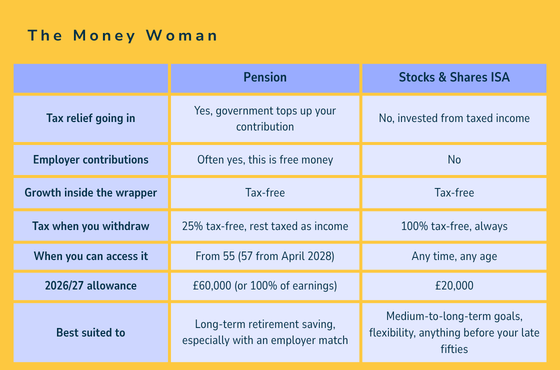
Make it stand out
Whatever it is, the way you tell your story online can make all the difference.
So Which One Should You Prioritise?
Here’s the order I’d be thinking about:
Get the full employer match first, before anything else on this list. Turning down free money makes no logical sense.
Ask yourself what the money is for and when you’ll need it. If there’s a chance you’ll need it before the pension age (55 or 57) then it just can’t go into your pension, full stop. So then it’s ISA time (specifically a LISA if you’re thinking of buying a first home).
If it’s for your retirement and you’ve reached your employer match, compare your tax rate now with what you expect it to be later. If it’s a higher rate now and lower later, then lean towards pension. If it’s similar rates on either side, or lower now and higher later then the flexibility of an ISA often wins. Thinking ‘I might need this money for something else eventually’ is a reasonable thing to consider.
Most people will benefit from having both - this is not a case of one or the other. You need a pension for the stuff you won’t touch for decades and an ISA for the life you live before then.
Your Next Actionable Step:
Don’t try and sort your entire retirement strategy tonight - just get one thing done. Check your last payslip or pension statement and confirm that you’re getting the full employer match. If not, that’s a five minute email to HR and it’s probably the single highest-return move you can ever make in your finances before you’ve even thought about ISAs.
Everything else on this page can wait a few days, let it percolate, and then - when you’re ready - make some decisions and get going!
Also please bear in mind…
I’m a financial coach, not a regulated financial adviser so this absolutely isn’t personal financial advice but general info and considerations to help you make sense of your choices. If your situation is complicated (maybe you’re self-employed, near retirement, a higher earner with tapering to think about) that’s the time to contact a regulated adviser.
Love Eleanor Xxx
